
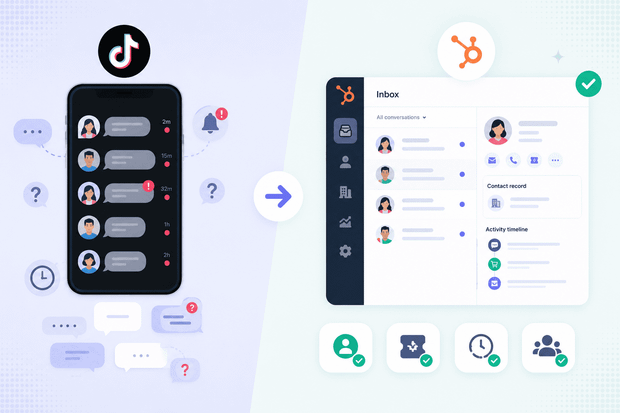
TikTok quietly became a customer service channel, and most support teams weren't ready for it.
Customers use DMs daily to ask about products, especially in LATAM, Southeast Asia, and the Middle East.
Since they expect fast responses, managing TikTok DMs volume from a phone or a social media app isn’t really scalable. On top of that, managing them outside CRMs means there’s no way to connect their messages to tickets or contact records.
In this article, we give you 5 benefits you get when you connect TikTok to HubSpot.
Why TikTok DMs are becoming a customer service channel
TikTok grew rapidly in LATAM, Southeast Asia, and the Middle East. That made it a primary channel where customers discover and engage with brands. Simply put, the concept of TikTok for Business isn’t no foreign anymore.
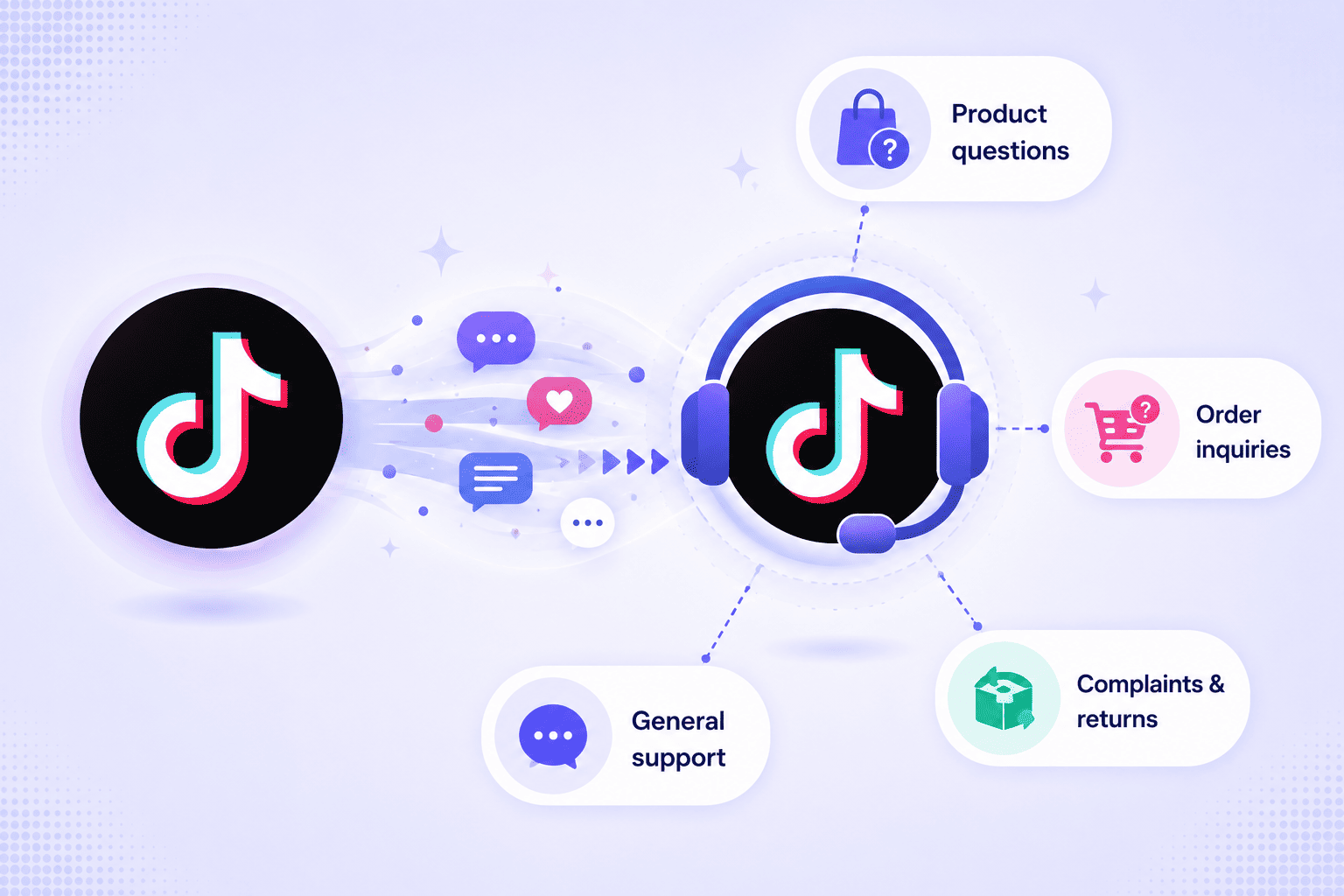
The types of DMs brands receive on TikTok today include:
- Product questions after watching a video or a TikTok Live
- Order inquiries and post-purchase follow-ups
- Complaints and return requests
- General support requests from customers who find it easier to DM than send an email
This volume only grows large, but TikTok’s capabilities don’t. TikTok's native DM management tools are still too limited to use for managing customer support.
What happens when you manage TikTok DMs outside the CRM
If your team is managing TikTok customer service from the app, this will sound familiar:
- There is no assignment or accountability. TikTok DMs get handled from a shared phone or a single account. There is no way to assign a conversation to a specific agent.
- When the person managing TikTok is unavailable, DMs go unanswered. There is no fallback. The customer is left waiting with no indication that anyone will respond.
- There is no ticket trail. When a customer follows up, the team has no record of the previous exchange. Agents start from scratch every time, and customers have to repeat themselves.
- Customers are treated as separate contacts across channels. A customer who messages on TikTok and later contacts support via WhatsApp or email appears as two unrelated contacts.
- Response times are unmeasurable. Without a CRM social media integration, there is no way to track how long TikTok DMs go unanswered.
- Managers have no visibility. There is no reporting on TikTok support volume, response rates, or conversation quality.
- When team members change, conversation history disappears. If the person managing your TikTok account leaves, the context goes with them. There is no record in the CRM.
5 benefits of managing TikTok DMs in HubSpot
Support teams who handle TikTok customer service outside their CRM face the same issues: missed messages, no contact history, untrackable response times, and zero visibility for managers.
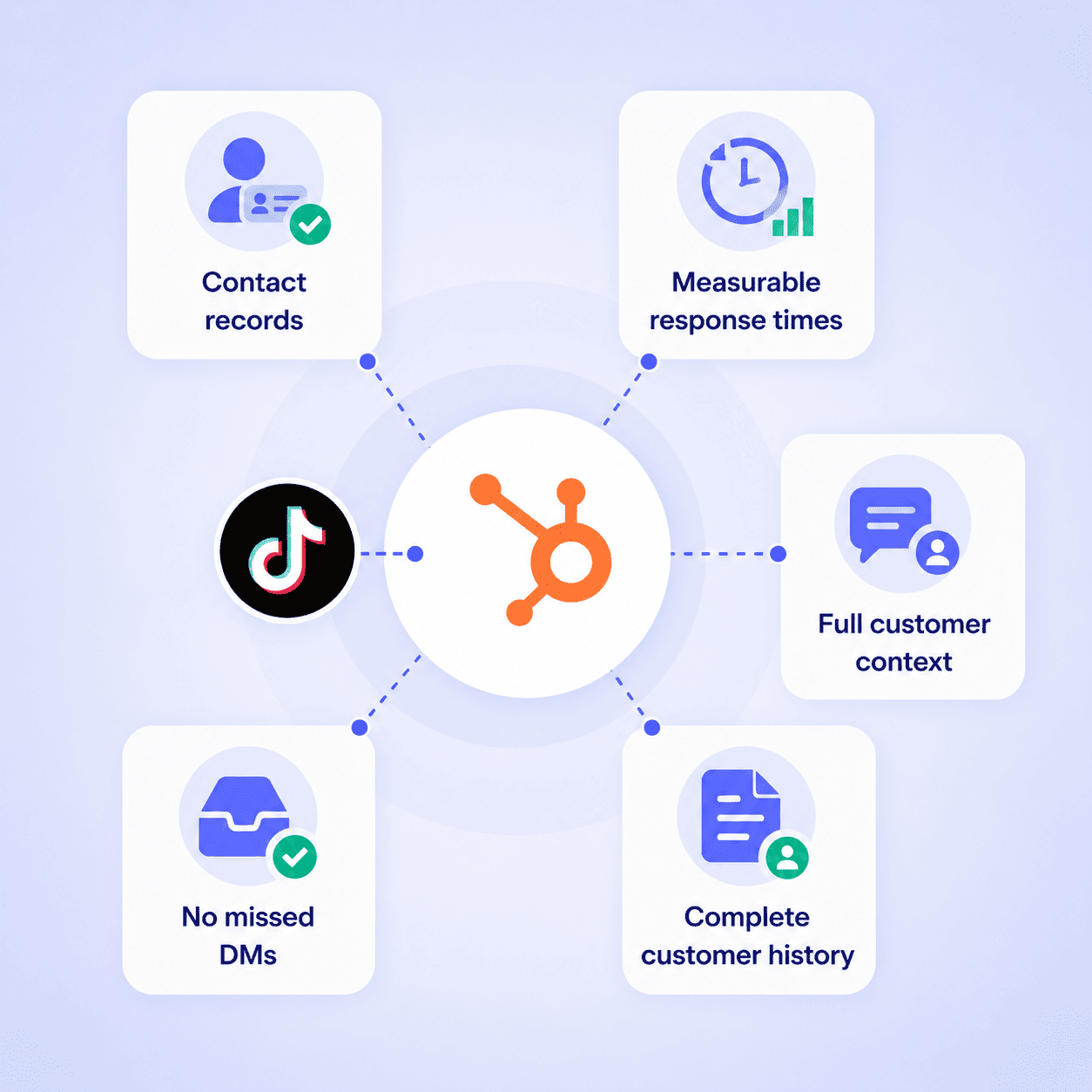
Here is what changes when teams work with a TikTok HubSpot integration.
1. Every TikTok customer conversation gets a contact record
The most immediate change when you connect TikTok DMs to HubSpot is that TikTok users stop being anonymous.
- Every new sender automatically gets a contact record in HubSpot
- All messages become a part of the CRM, linked to purchase history, prior support tickets, and any interactions across other channels.
- Your agents get context instantly
That contact record is the foundation everything else builds on.
2. Response times become measurable and manageable
Once you know who your TikTok customers are, the next question is how well you are serving them. When TikTok messages arrive in HubSpot:
- SLA rules apply to them the same way they apply to email
- Managers can see exactly how quickly the team is responding
- It’s easier to identify bottlenecks and report on TikTok customer service CRM performance
What gets measured gets managed. And for the first time, TikTok support is something you can actually measure.
3. No DM gets missed when the team is busy or unavailable
A single person managing TikTok DMs from a phone is a single point of failure. When they are unavailable, the channel goes dark.
When TikTok conversations arrive in HubSpot, the following happens:
- Messages queue as structured conversations that can be assigned across the team
- Teams can manage conversations in shifts or track till resolution
- Teams handle high-volume moments systematically rather than reactively
4. Agents reply with full customer context
When a customer DMs your brand on TikTok, the support agent needs context to give a useful reply.
When you connect TikTok to HubSpot inbox, the full contact history is right there before they type a word. They can access:
- Prior support interactions
- Order history
- Previous conversations across other channels
Agents go into every TikTok reply informed, so customers never have to repeat themselves and no reply misses the mark.
5. TikTok becomes part of the full customer record
Every TikTok DM a customer sends becomes a part of permanent history in HubSpot.
The different ways teams can use this customer history:
- Sales teams can review TikTok conversations before a follow-up call
- Support managers can trace the full journey from a customer's first TikTok message to their latest ticket
- Marketing teams can segment contacts by TikTok engagement
What changes for support teams when TikTok connects to HubSpot
When support teams connect TikTok to HubSpot, a lot of their work changes, for both agents and managers.
For agents
- TikTok DMs appear in the same HubSpot inbox as email, WhatsApp, and Instagram
- Every conversation comes with a contact record attached
- Replies are sent from inside HubSpot and delivered directly to the customer on TikTok
For managers
- TikTok DM volume becomes measurable for the first time
- Response times and resolution rates are tracked in HubSpot alongside every other support channel
- Conversations are assigned and queued inside HubSpot
Which teams benefit most from TikTok DM management in HubSpot
Not every brand is at the point where TikTok DMs require a CRM connection. If you want to know whether your team needs the TikTok HubSpot connection or not, here’s a quick guide of which teams need it the most.
Consumer brands with high TikTok engagement
- Fashion, beauty, food, electronics, and lifestyle brands running active TikTok content receive the highest DM volumes.
- When that volume reaches a point where your team can't manage it from a phone, connecting TikTok to a social media customer service CRM is the natural next step.
E-commerce brands selling through TikTok Shop
- Post-purchase support requests coming through TikTok DMs are high-intent and time-sensitive.
- Customers who bought through TikTok expect support through the same channel, and having those conversations inside HubSpot means agents already have order history when they reply.
Brands serving LATAM, Southeast Asia, and Middle East markets
- TikTok engagement is highest in these regions, and for brands primarily serving these markets, TikTok is often the primary customer communication channel rather than a secondary one.
Start using TikTok with HubSpot today
TikTok DMs are already a support channel for most consumer brands in LATAM, Southeast Asia, and the Middle East. The only question is whether your team is managing them properly.
Teams connecting TikTok to HubSpot do so through tools like Octopods, which brings TikTok Business DMs directly into the HubSpot inbox. It is available for TikTok Business Accounts outside the US and EU.
If you are ready to understand exactly how the connection works and what your team can do inside HubSpot once it is live, how to manage TikTok DMs in HubSpot covers the full setup and workflow.
Ready to bring your TikTok DMs into HubSpot?
We can help you confirm your account is supported and get everything connected.
FAQs
Why should support teams manage TikTok DMs inside a CRM?
Managing TikTok DMs inside a CRM means every conversation is tied to a contact record, response times are trackable, and no message gets missed because one person was unavailable.
Is TikTok becoming a customer service channel for businesses?
Yes, particularly in LATAM, Southeast Asia, and the Middle East, where TikTok has some of its highest engagement rates. Customers in these markets are already using TikTok DMs to ask product questions, follow up on orders, and request support.
What is the problem with managing TikTok DMs from the TikTok app?
TikTok has no assignment, no ticketing, no SLA tracking, and no connection to the rest of your support stack. One person manages everything from a phone, conversations have no record in the CRM, and when that person is unavailable the channel goes dark.
Which businesses benefit most from connecting TikTok to HubSpot?
Consumer brands with high TikTok engagement, e-commerce brands selling through TikTok Shop, and brands primarily serving markets in LATAM, Southeast Asia, and the Middle East benefit most.