
Quick summary
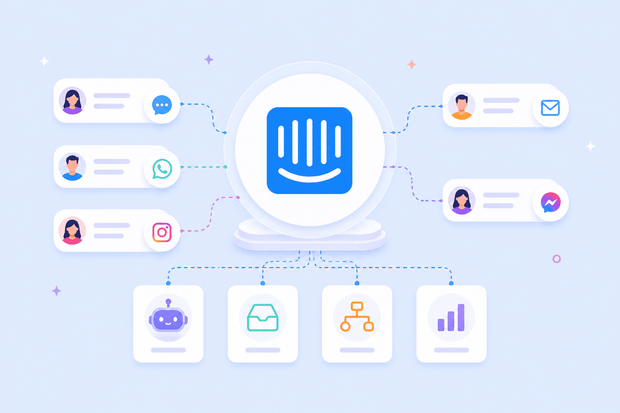
- Intercom is an AI-powered customer service platform built for modern support teams.
- It combines live chat, automation, ticket management, and a help center in one place.
- Its AI tools, Fin AI Agent and Copilot, help teams resolve issues faster and at scale.
- It connects with CRMs, analytics tools, and messaging apps, and Octopods make it easy to bring WhatsApp, Instagram, and more into one inbox.
- Best for teams that want fast, personalized, omnichannel support.
If you've ever researched AI customer service tools, you've almost certainly come across Intercom. But what exactly is the Intercom platform, and why are so many support teams making it their go-to solution?
Intercom is a customer service platform that helps businesses deliver fast, personalized support across multiple channels, from live chat and email to social messaging and more.
To provide conversational support and build scalable operations, you need to understand how Intercom works and it connects to your existing tools.
In this guide, we'll cover:
- The key features of Intercom
- How businesses use Intercom for customer support
- How Intercom compares to other support platforms
- Intercom limitations you should know about
What is Intercom?
Intercom is an AI customer service platform that helps businesses manage customer conversations across chat, email, and messaging apps, all from a single inbox.
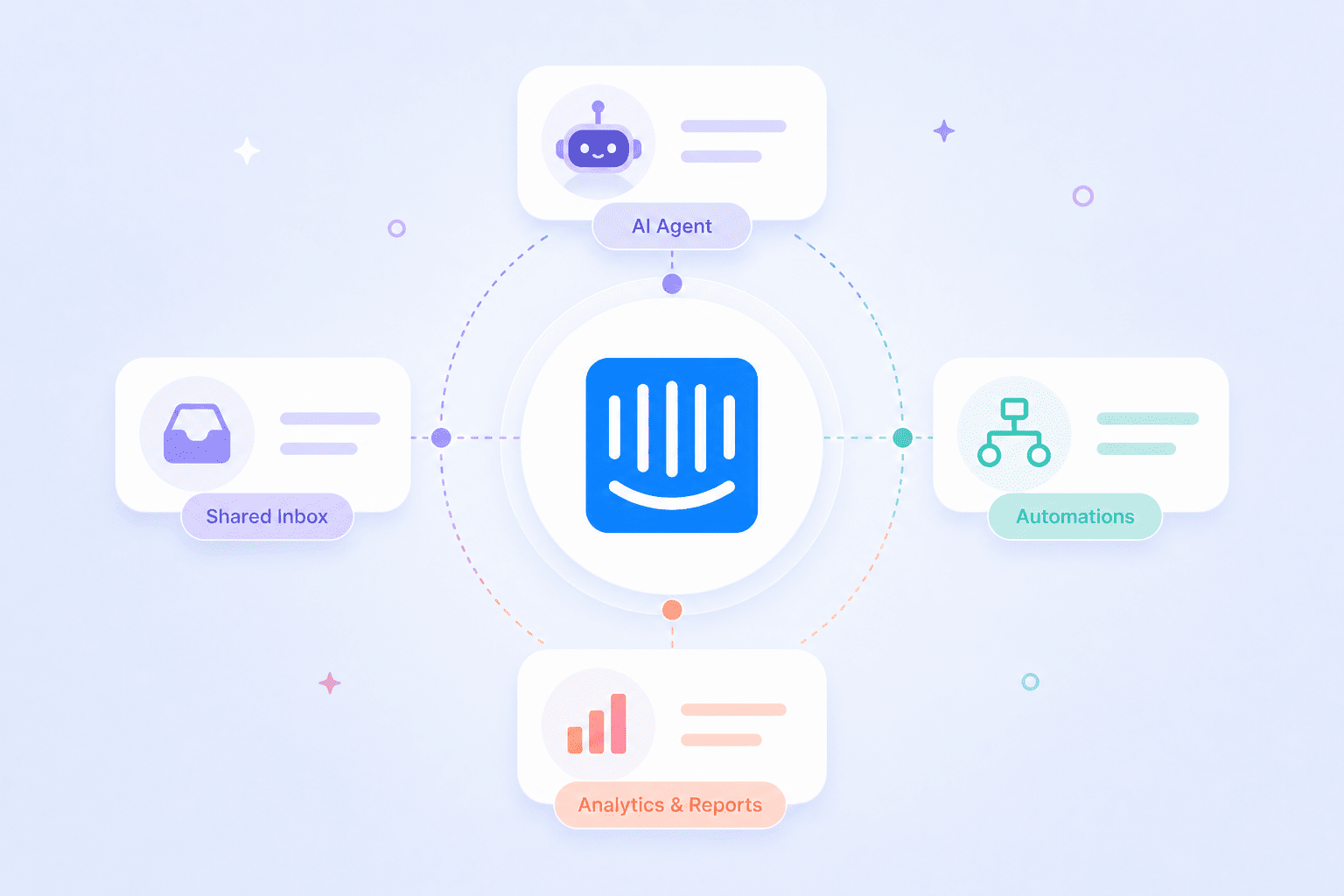
It combines a shared inbox, automation workflows, and Fin AI, its built-in AI support bot, to help support teams resolve issues faster and deliver more personalized service at scale.
A brief history of Intercom
Founded in 2011, Intercom started as a simple in-app chat tool with one goal: making online business communication feel more human.
Over the years, it evolved from a messaging widget into a full customer service software platform, now trusted by thousands of companies worldwide.
Today, Intercom's mission is to combine AI, messaging, and human support into one smooth experience.
What type of tool is Intercom?
Intercom is best described as an AI-powered customer communication platform. It sits at the intersection of:
- Help desk software — ticketing, inbox management, SLA tracking
- Live chat software — real-time messaging on web and mobile
- AI customer support — automated responses and resolution via Fin AI
- CRM-lite — customer data, conversation history, and segmentation
This makes it a strong choice for teams that want to consolidate their support stack into one platform.
Key features of Intercom
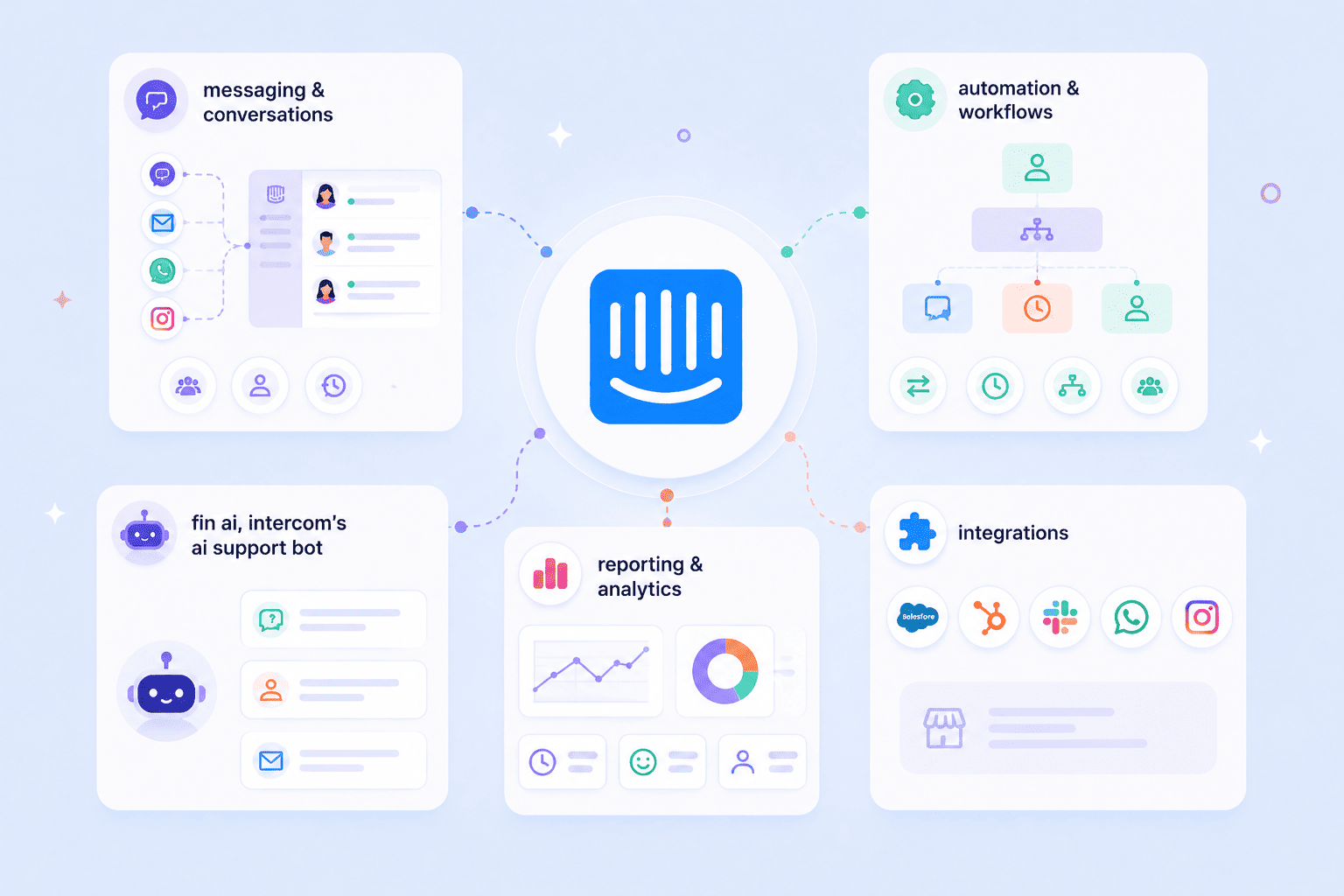
Intercom has messaging, automation and AI features that differentiate it from other customer service tools. If you want your support team to work faster and build better customer relationships, take a look at Intercom’s key features.
Messaging and conversations
Intercom’s biggest strength is its messaging system. It lets businesses reach customers through live chat widgets, support emails, and third-party messaging apps.
All Intercom messages flow into an AI-powered customer support inbox.
From that inbox, support agents can:
- Collaborate on conversations in real time
- Assign and reassign chats to the right team member
- Track full conversation history and customer context without switching tools
Automation and workflows
Intercom's automation tools help teams stay organized and eliminate repetitive manual work. Support managers can:
- Set up assignment rules to route conversations automatically
- Define SLAs to improve response times
- Build custom workflows that move tickets through the right steps
- Use workload management
The result: fewer dropped conversations, faster resolutions, and a more organized team.
Fin AI agent, Intercom's AI-first support tool
Intercom's biggest differentiator in the AI customer support space is Fin, its intelligent AI agent. Fin is purpose-built for customer service and goes well beyond basic chatbot functionality.
Fin AI can:
- Instantly resolve FAQs and repetitive queries
- Escalate complex issues to human agents with full context
- Operate across live chat, email, and tickets simultaneously
Reporting
Intercom gives support teams a real-time view of their performance through flexible, AI-enhanced reporting dashboards. Key metrics you can track include:
- Response and resolution times
- Customer satisfaction (CSAT) scores
- AI vs. human resolution rates
- Team workload and throughput
Integrations
Intercom connects with the tools your team already uses — CRMs, analytics platforms, and messaging apps like WhatsApp, Instagram, and more. All available integrations are listed in the Intercom App Store, including native integration and third-party integration tools..
Integration tools like Octopods make it easy to bring all your messaging channels into Intercom. Combined with Intercom's AI and support features, these integrations give you a solid stack and smooth operations.
Watch how Fin AI handles customer conversations across multiple messaging channels inside Intercom:
How do businesses use Intercom
For years, businesses used Intercom to run their entire customer support workflows across different teams and business growth stages.
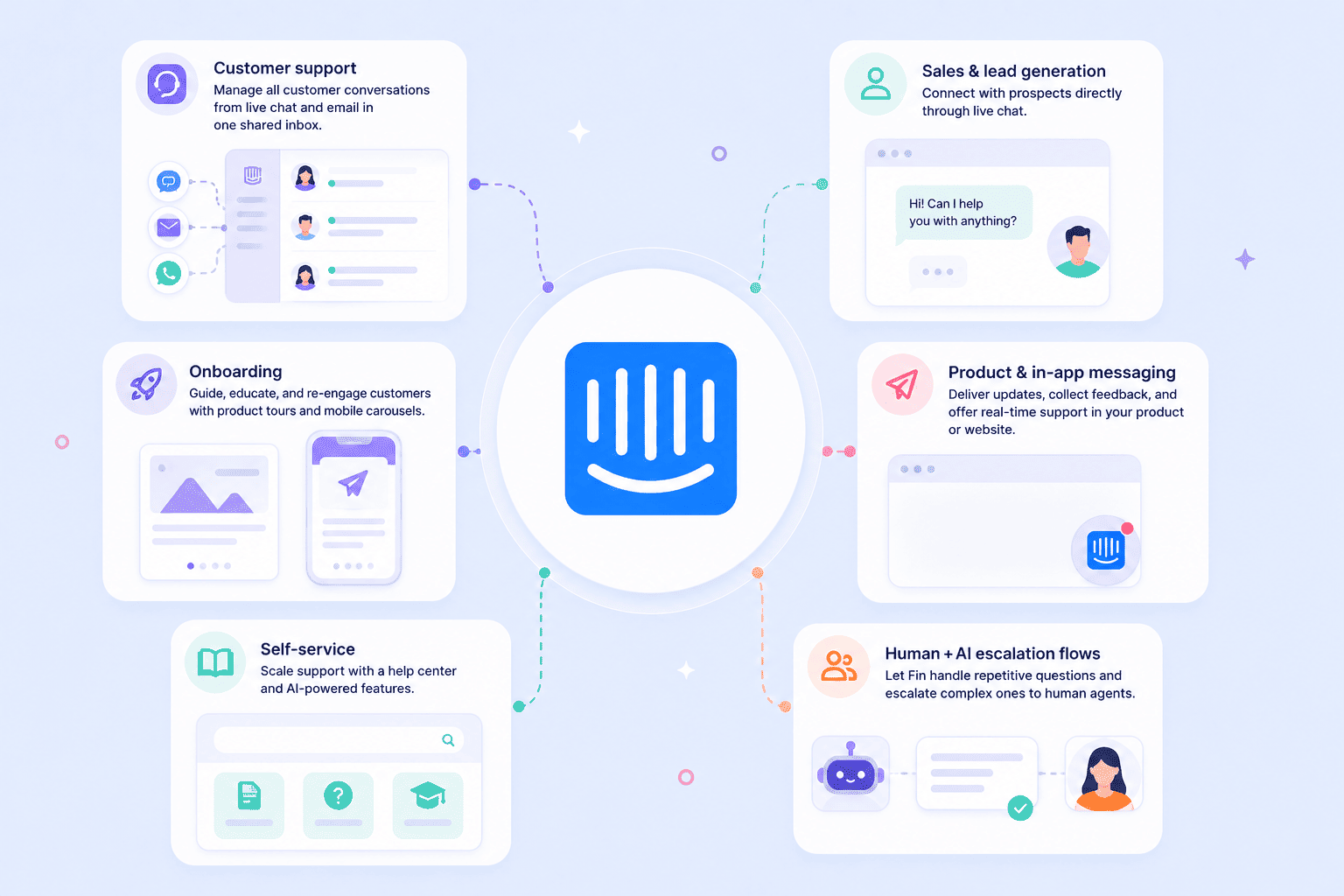
Below is a summary of Intercom’s most common use cases for businesses:
- Customer support: Business mainly use Intercom to manage all customers conversations from live chat and email in one shared inbox.
- Sales and lead generation: Intercom helps sales teams connect with prospects directly through live chat.
- Onboarding: Intercom offers interactive tools that guide, educate, and re-engage customers. Its Product Tours walk users through key features step by step, while mobile carousels welcome app users.
- Product and in-app messaging: Companies use Intercom’s Messenger widget to deliver updates, collect feedback, and offer real-time support directly inside their product or website.
- Self-service: Intercom helps businesses scale their customer service with its built-in help center and AI-powered features.
- Human + AI escalation flows: Businesses using Intercom combine human expertise and automation by letting Fin handle repetitive questions and escalating complex ones to human agents.
This is what modern AI customer support looks like in practice
What are the key Intercom alternatives
When comparing Intercom vs other customer service platforms, businesses often look for tools that combine automation, AI, and ease of use. Many of Intercom competitors offer all three, and at different price points.
Here’s a quick comparison between Intercom and its top alternatives: HubSpot Service Hub, Zendesk, Freshdesk, Drift, and LiveChat.
| Platform | Key Features | Ease of Use | Pricing | Integrations |
|---|---|---|---|---|
| Intercom | AI-first support, Fin AI Agent, omnichannel inbox, automation workflows | Intuitive for support-focused teams | Starts at $29/seat | 300+ native + connector apps |
| HubSpot Service Hub | Omnichannel help desk, Breeze AI | Very user-friendly, especially for existing HubSpot CRM users | Free tier available, paid from $20/seat | 1,500+ integrations |
| Zendesk | Advanced ticketing, conversational AI agents | Steep learning curve; heavy customization and add-ons often needed | From $19/agent/month | Large marketplace, strong API |
| Freshdesk | Omnichannel support, Freddy AI | Clean and intuitive interface | From $18/agent/month | CRMs and connector apps |
| Drift | AI live chat, automatic routing | Easy for sales teams, limited for support | Usage-based pricing | Limited |
| LiveChat | AI chatbots, real-time chat | Lightweight and easy to adopt | From $25/agent/month | 200+ integrations |
So which platform comes out on top?
The right choice depends on what your team actually needs:
- HubSpot Service Hub is a natural fit if your team already runs on HubSpot CRM
- Zendesk suits large enterprises that need deep customization and complex ticketing
- Freshdesk is a solid budget-friendly option for smaller teams
- Drift is built for sales-led teams, not support-first operations
- LiveChat works well as a lightweight standalone chat tool
Intercom stands out for teams that want AI at the core of their support operation. With Fin AI handling frontline conversations, a true omnichannel inbox, and powerful automation workflows, it's the strongest choice for support teams that need to scale without growing headcount.
Looking for a fuller picture?
We ranked and reviewed the 10 best customer service platforms in 2026, including pricing, AI features, and who each tool is best for.
Why choose Intercom for customer service
Choosing the right customer service platform depends on your team’s size, goals, and the kind of experience you want to deliver.
Here’s why businesses choose Intercom for customer service.
AI that works on two levels
Most AI customer support tools focus on the customer-facing side. Intercom goes further by covering both sides of the conversation:
- Fin AI handles frontline customer interactions, resolving FAQs, answering queries, and escalating when needed
- Copilot works behind the scenes, giving human agents instant insights, suggested replies, and context so they resolve issues faster
A unified platform
Unlike patchwork solutions that stitch together disconnected tools, Intercom brings chat, automation, analytics, help desk, and AI into a single platform. Agents work from one inbox, managers report from one dashboard, and customers get a consistent experience across every touchpoint.
When connected to multiple messaging channels, Intercom acts as a full omnichannel support hub.
Strong developer ecosystem
For teams with specific needs, Intercom's open APIs and developer-friendly environment make it easy to:
- Build custom workflows tailored to your operations
- Integrate with niche or internal tools not found in the App Store
- Extend Intercom's capabilities well beyond its native feature set
This makes it a strong long-term investment for growing teams that don't want to outgrow their support stack.
What are challenges of using Intercom?
While Intercom is one of the most advanced AI chatbot and customer messaging platforms, users often mention a few challenges to watch out for:
- Complexity: Setting up flows, rules, and integrations can take time, especially for teams new to automation or managing multiple websites using Intercom.
- Over-relying on AI and automation: AI can occasionally hallucinate or misinterpret messages, so teams need clear escalation paths for edge cases.
- Integration: As businesses scale, syncing data between Intercom, CRMs, and messaging systems can be complex. This is where integrations become essential.
- Pricing unpredictability: Intercom’s usage-based and per-resolution pricing, especially with AI features, can make costs harder to calculate.
Intercom pricing 2026: Plans & cost breakdown
Intercom offers three main support plans, Essential, Advanced, and Expert, all powered by the Fin AI Agent at $0.99 per resolution. Its pay-per-resolution model makes it flexible for businesses of all sizes, from startups to large enterprises.
- Essential ($39/seat): Best for small teams. Includes Fin AI Agent, Messenger, shared inbox, ticketing, reports, and a help center.
- Advanced ($99/seat): Built for growing teams. Adds workflow automation, multiple inboxes, round-robin assignment, and multilingual help centers.
- Expert ($139/seat): Designed for large organizations. Includes all Advanced features plus SSO, HIPAA support, SLAs, and multi-brand functionality.
Explore more details on Intercom's pricing here.
Final thoughts: Is Intercom the right customer service for you?
For most businesses that want to deliver fast, scalable, and personalized support, yes, Intercom is worth it.
It brings together messaging, automation, and AI in one platform, with Fin at the center, an AI support bot that handles frontline conversations, resolves issues instantly, and hands off to human agents when it matters.
That said, it's the strongest fit for teams that are ready to invest in proper setup and integrations.
Out of the box, Intercom is powerful. Connected to your full messaging stack, it becomes an omnichannel AI customer service tool that's hard to match.
That's where Octopods comes in, connecting Intercom to WhatsApp, Instagram DMs, and Facebook Messenger so every customer conversation reaches your team, no matter where it starts.
Ready to get more out of Intercom by connecting your messaging channels to it?
Discover how Octopods works by chatting with our team.
FAQs
What is Intercom platform?
Intercom is an AI customer support platform that helps businesses engage with their customers through messaging, automation, and AI. It unifies customer conversations from different channels into a single, shared inbox, enabling real-time chat, AI-powered support, and automated workflows.
Is Intercom a CRM or a helpdesk tool?
Intercom is primarily a customer service and helpdesk platform, not a full CRM. It’s built to help businesses manage customer conversations, tickets, and support workflows through chat, email and messaging apps in 1 inbox.
Is Intercom only for customer support?
No, while Intercom is widely known as a customer support platform, it also offers powerful tools for sales, marketing, and customer engagement. Businesses use it to qualify leads, onboard users, announce new features, and automate follow-ups. Its combination of messaging, automation, and AI makes it useful across the entire customer lifecycle.
Is Intercom good for small businesses or startups?
Yes. Intercom is a great choice for small businesses and startups that want to deliver fast, personal customer support without building a large team.
What is Fin AI in Intercom?
Fin is Intercom's built-in AI Agent, designed to handle customer queries automatically across chat, email, and tickets. It can resolve FAQs instantly, take actions on behalf of customers, and hand off to human agents with full context when needed.
Is Intercom better than Zendesk?
It depends on your team's needs. Intercom is stronger for AI-native, messaging-first support, It depends on your team's needs. Intercom is stronger for AI-native, messaging-first support — especially for SaaS and mid-market teams. Zendesk has deeper enterprise ticketing and more mature IT helpdesk features. If AI resolution rates and omnichannel messaging are priorities, Intercom has the edge especially for SaaS and mid-market teams. Zendesk has deeper enterprise ticketing and more mature IT helpdesk features. If AI resolution rates and omnichannel messaging are priorities, Intercom has the edge.