
Choosing the right customer support platform isn’t easy. The market is full of tools promising faster replies and smoother workflows. But two names keep popping up in almost every conversation: Intercom and Zendesk.
Both are trusted by global brands, yet they approach customer support from two very different angles. Zendesk is built around structured ticketing and enterprise-grade workflows. Meanwhile, Intercom leans into conversational, AI-first support that feels more personal and real-time.
In this article, we’ll take an objective look at both tools to help you decide which one best fits your support model.
What is the key difference between Zendesk and Intercom?
Both Intercom and Zendesk are customer support platforms that help teams manage conversations and tickets. But what sets them apart?
Zendesk is built around ticketing, while Intercom is built around customer conversations.
In Zendesk, customer issues become tickets that move through structured workflows till they’re resolved. It’s a solid system for large teams that deal
Some of Zendesk’s key features include:
- Omnichannel ticket management where requests from email, chat, phone, and social apps live in one workspace
- Advanced workflow automation to route and escalate tickets
- Routing and control to assign tickets to specific teams or agents
- Connections with CRMs, collaboration tools, and back-office systems
On the other hand, Intercom has a conversation-first model. It combines its Helpdesk with Fin AI to make conversing with customers a breeze. It also combines automation and live support in one thread, so agents can move smoothly between chats and tickets.
Intercom’s key conversational support features include:
- Fin AI, an intelligent support agent that takes care of customer conversations from start to end
- Native integrations with multiple messaging apps and connections to third-party connector tools
- Centralized portals for tickets where agents can have side conversations and overlook tickets
- Shared inbox where support teams can collaborate
If you’re asking, is Zendesk or Intercom better for support teams?
Intercom leads in conversational support. Its chat-first approach and AI assistance makes customer interactions faster and more personal. Its style fits modern support teams perfectly.
Meanwhile, Zendesk is better for large support teams handling high volumes of requests. It’s suitable for teams that need better organization, accountability, and tracking.
Intercom vs Zendesk features comparison
When teams compare Intercom and Zendesk features, the biggest differences usually show up in team collaboration, conversation management, and customer experience.
Both platforms cover the basics, but they’re designed for very different support realities. One prioritizes structured resolution. The other prioritizes ongoing conversations and relationships.
Communication & shared inbox
Customers don’t think in tickets. They send messages, follow up later, and expect the conversation to continue without starting over. This is where the gap between Intercom and Zendesk becomes clear.
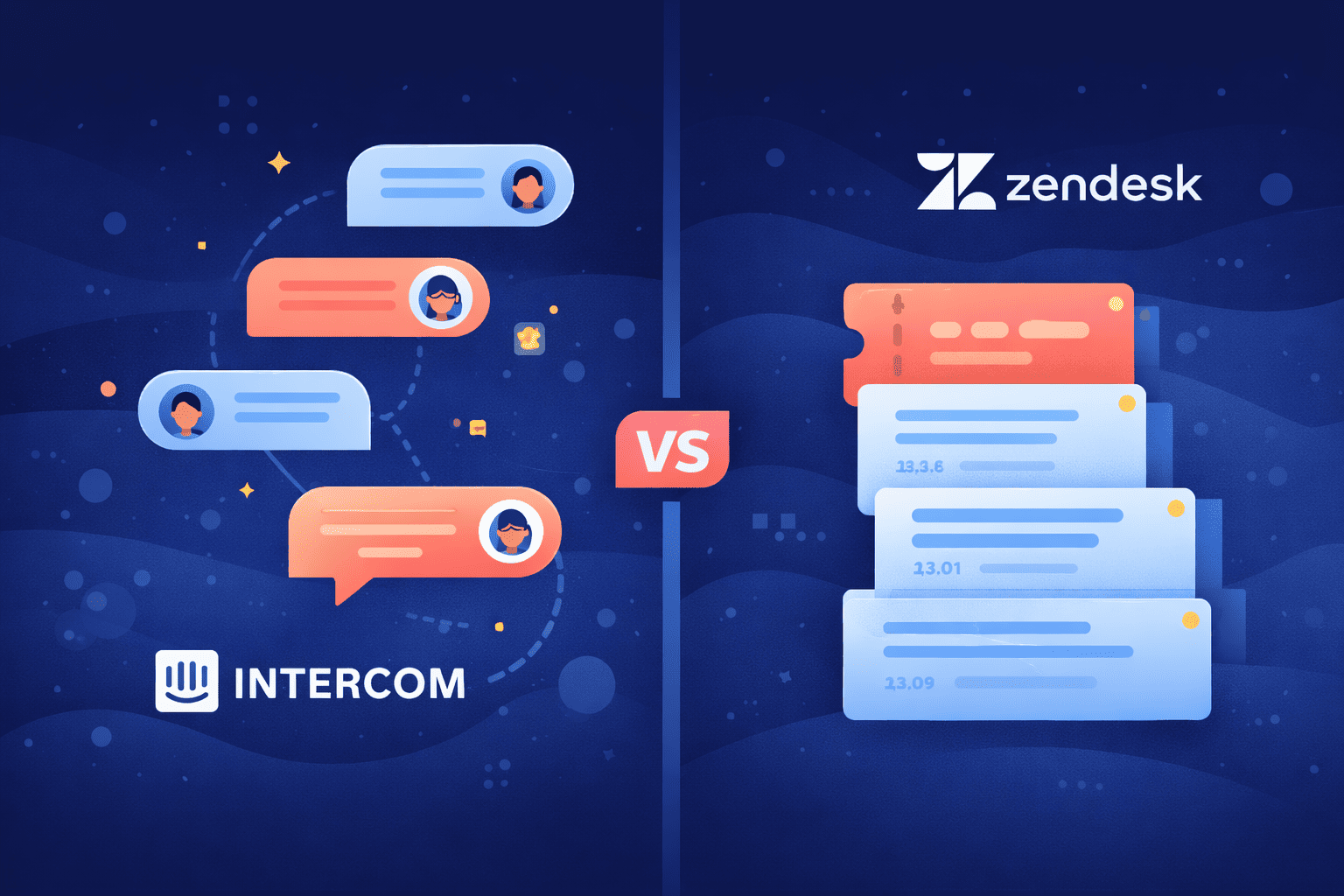
Intercom is a unified inbox for chat, email, and in-app messaging. Conversations stay in a single thread, and customer context is always visible. Agents can collaborate in real time without using new tools. This results in quicker replies and smoother handoffs.
On the other side, Zendesk is a ticket-based system built around case views. Messages are organized and tracked well, but conversations feel more transactional. Customers often experience support as a sequence of tickets rather than a continuous dialogue.
Automation & AI
Automation usually breaks in two places. Either it feels robotic to customers, or it creates more work for agents. This is where the Intercom and Zendesk features gap becomes obvious.
In Intercom, Fin AI resolves common questions automatically and hands off complex issues with full context.
On top of that, Copilot supports human agents during live conversations with suggestions and guidance. Automation flows are designed to feel like real conversations instead of scripted steps.
Zendesk relies on macros, triggers, and Zendesk AI to automate support workflows. It works well for moving tickets through queues, but natural language conversations feel more limited and rule-based.
Integrations
Integrations often decide how fast a support team can move. When tools aren’t connected, agents have to use multiple tabs, and it causes delays.
Intercom offers hundreds of integrations across CRM, analytics, and messaging through its App Store and open APIs.
It also supports direct connections to messaging apps and channels through third-party integration tools like Octopods.
Octopods lets teams manage WhatsApp, Telegram, and other channels inside Intercom, a native inbox experience. This enables users to use Intercom’s key features across all popular messaging apps.
Zendesk, on the other hand, provides a large integration marketplace with strong coverage for ITSM, enterprise systems, and internal support tools. It fits well into complex internal stacks where tickets need to move between departments and systems reliably.
The difference comes down to philosophy. Intercom is built around cross-channel customer engagement, keeping conversations connected across tools and touchpoints.
Zendesk is built around internal support stack connectivity, making sure tickets flow smoothly across enterprise systems.
UX & UI
User experience matters more than most teams expect. When the interface slows agents down or hides context, it affects performance, and consequently, customer experience.
Intercom has a clean, modern, chat-style interface designed for speed. Conversations, customer context, and collaboration tools are easy to access in one view, which helps agents respond faster without jumping between screens.
Zendesk offers a ****classic dashboard built for scale and operational control. It handles large volumes well, but the interface can feel complex or dated, especially for teams focused on real-time conversations.
Reporting & Analytics
Reporting usually answers one of two questions: Are customers getting help fast? or Are our support operations under control? Intercom and Zendesk lean into different answers here.
Intercom offers visual, easy-to-read dashboards focused on conversations, team responsiveness, and AI performance.
You can quickly see things like response times, resolution speed, conversation volume, and how often Fin AI resolves issues without human help.
Insights are designed to be actionable without needing deep reporting expertise.
Zendesk has granular analytics built for operational depth. Teams can track SLAs, ticket lifecycle stages, agent efficiency, and long-term trends across channels using enterprise-grade reporting tools.
This level of detail supports compliance and large-scale operations but often requires more setup and ongoing maintenance.
Pricing
Pricing is one of the first questions support leaders ask when comparing Intercom vs Zendesk, and the two platforms take very different approaches.
Intercom’s pricing is seat-based with scalable plans (like Essential, Advanced, and Expert) and usage-based charges for AI and messaging.
You pay per teammate seat, and AI like Fin resolves conversations at roughly $0.99 per resolution on top of that. This lets you start small and dial up automation, but it can feel flexible and confusing if you’re not sure how usage will grow with volume.
Zendesk has tiered plans that price per agent seat (from basic support options up to enterprise suites). The model feels predictable because costs are tied to plan levels and headcount rather than usage, though costs can add up as you scale agents and upgrade tiers.
Neither model is strictly cheaper across every scenario.
Intercom can cost more with heavy AI or volume, while Zendesk can become expensive when you need higher tier features across many agents..
Which one is the right customer service platform for you?
Intercom and Zendesk are both leaders, just in different categories.
Intercom is built for modern, AI-driven conversations. It focuses on real-time engagement and automation that feels human.
Zendesk is built for structured, enterprise-grade support. It focuses on ticket control, workflows, SLAs, and operational consistency at scale.
Neither is “better” across the board. The right choice depends on how your team works and how your customers expect to be supported.
You can go with Intercom if you:
- Offer conversational support
- Rely on AI to deflect volume and support customers proactively
- Support users across multiple messaging channels
However, Zendesk will suit you better if you:
- Run a ticket-heavy, process-driven support operation
- Need strict workflows, SLAs, and compliance tracking
- Manage large agent teams handling high request volumes
FAQs
Is Intercom better than Zendesk for small teams?
Yes, Intercom is often better than Zendesk for small teams because it focuses on real-time conversations and AI-powered automation. Small teams benefit from its faster setup, conversation-first inbox, and tools like the Fin AI Agent that reduce manual work. Zendesk can feel heavy and complex for teams that don’t need enterprise workflows or large-scale ticket management.
What is the best Zendesk alternative?
Intercom is widely regarded as one of the best Zendesk alternatives. It stands out among Zendesk competitors for its AI-first approach and unified messaging inbox. Teams looking for a conversational, modern support platform often choose Intercom when exploring Zendesk alternatives.
What is the difference between Zendesk and Intercom?
The main difference between Zendesk and Intercom is their approach to support. Zendesk is ticket-based and built for enterprise workflows and large-scale operations. Intercom is conversation-first and AI-driven.
Does Zendesk have AI like Intercom's Fin?
Zendesk offers AI features for routing tickets, suggesting responses, and automating workflows. Intercom Fin goes further, acting as a virtual agent that can resolve customer questions automatically.
Can you connect Intercom & Zendesk to messaging apps?
Yes, Intercom supports native integrations with WhatsApp, Telegram, and other messaging apps and also allows third-party integration tools like Octopods. Zendesk supports messaging via Zendesk Messaging and third-party integrations.